Reviewed September 28, 2026 by Rachel Mederos, MS, CCC-SLP. Summit Speech Therapy Inc, a Utah-licensed speech-language pathology practice.
AAC therapy at Summit Speech Therapy gives Utah children and adults a reliable way to say what they mean using low-tech tools, high-tech speech-generating devices, and partner training. Augmentative and alternative communication does not stop speech from developing. It reduces pressure and often supports spoken language while giving someone a voice now. Rachel Mederos MS CCC-SLP, Carrie Ashcraft MA CCC-SLP, and Mark R. Plumley include AAC in their clinical work. Care starts with a free phone consult. Clinics serve Bountiful, Layton, and Murray.
AAC means a voice, not a surrender of speech
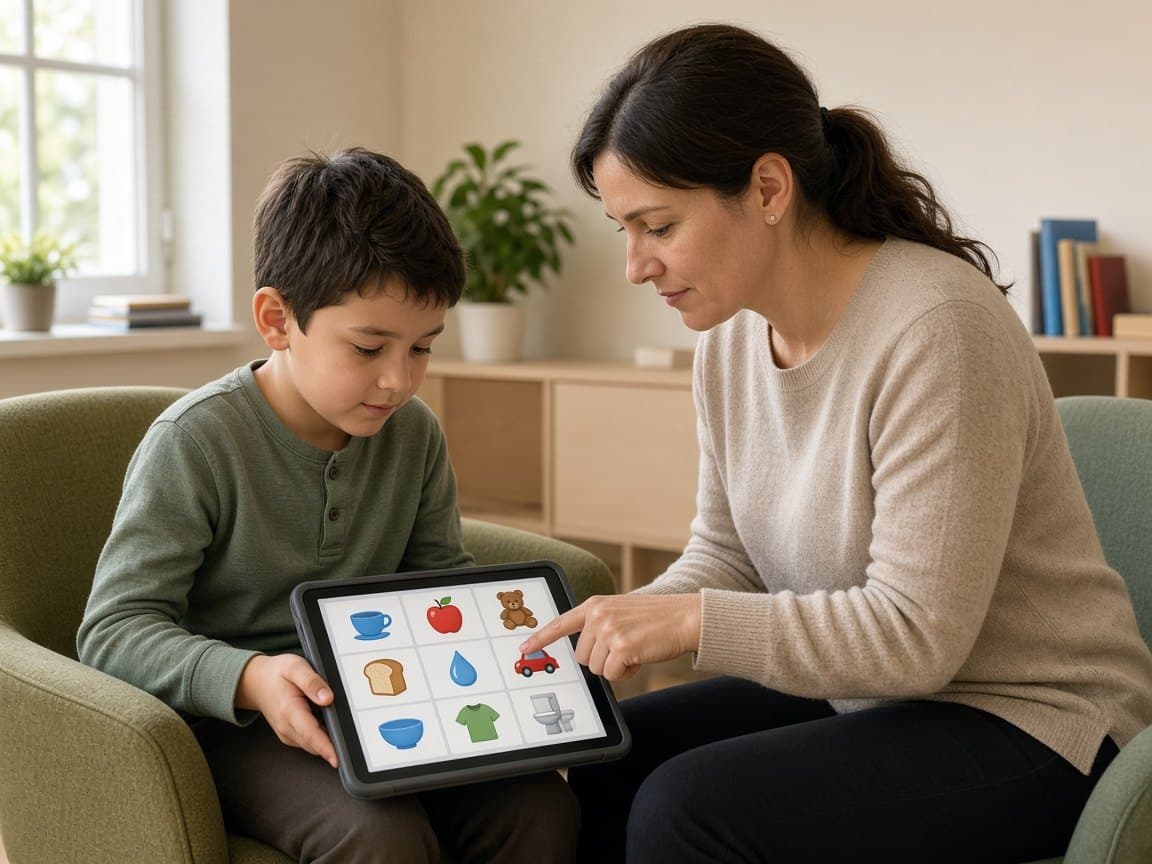
Augmentative and alternative communication includes gestures, picture systems, communication books, apps, and speech-generating devices. The shared purpose is functional communication when speech alone cannot carry the message.
Families sometimes fear that a device will make a child stop talking. Clinical experience and research direction for many children show the opposite pattern. AAC can lower frustration and support language growth while speech continues to be practiced.
Adults with aphasia, ALS, or other neurologic disease may need AAC for part or all of the day. Using a device for safety and participation is not failure. It is access.
Summit watches spoken language throughout AAC care. Speech goals and AAC goals can live in the same plan without competing for the person’s right to communicate today.
Who benefits from low-tech and high-tech systems
Autistic clients, children with childhood apraxia of speech, and anyone whose speech only family can decode are frequent AAC candidates. Behavior that is clearly a missing word is often a communication emergency waiting for a system.
Adults recovering language after stroke or TBI may use AAC as a bridge. People with progressive disease may need proactive AAC planning before speech becomes unreliable in every setting.
Mark R. Plumley lists AAC and severe disabilities among his clinical focus areas, with twenty-five years in pediatric work. Rachel and Carrie also treat AAC across neuro and complex communication needs.
A device that was issued and then abandoned is still a clinical problem Summit can address. Unused equipment usually signals training or design failure, not a person who refuses to communicate.
- Behavior that functions as a missing request or protest word
- Speech that only familiar listeners can understand
- A device already issued that sits unused in a backpack
- Need for a system during illness, surgery recovery, or progressive decline
- School and home using different communication rules that confuse everyone
Matching the system to the person
Feature matching looks at vision, motor access, cognition, language level, and daily environments before a tool is chosen. The newest device is not automatically the right device.
Low-tech options remain powerful. A well-designed book or board that is always available can outperform a high-tech tool that is left charging in another room.
High-tech speech-generating devices help when voice output, extensive vocabulary, and flexible messaging are needed. Funding language and trials are part of clinical support when families are stuck in paperwork.
Access methods may include direct touch, switches, eye gaze, or partner-assisted scanning. Accuracy and fatigue guide the choice more than novelty.
Partner modeling turns devices into conversation
A device without modeling is furniture. Therapy teaches communication partners to use the system while speaking, not only to quiz the client for answers.
School teams and family members need the same core vocabulary targets. Mixed systems across settings create confusion and abandonment.
Summit helps with school implementation conversations when clinic recommendations and IEP services are not lined up. The goal is daily use, not a device that appears only during therapy hour.
Partners practice commenting and waiting, not only requesting drills. Rich language models teach more than a list of snack icons.
AAC across autism, apraxia, aphasia, and medical complexity
For autistic clients, AAC may support requesting, commenting, and social connection without forcing a single neurotypical script. Robust language systems are offered early rather than as a last resort after years of frustration.
For childhood apraxia, AAC can carry messages while motor speech therapy builds spoken words. The child deserves a way to communicate during the long motor learning process.
For aphasia and severe brain injury, AAC supports medical decisions, basic needs, and relationship contact. Coma recovery pathways may introduce simple AAC as alertness allows, without promising speech return on a timeline.
Carrie Ashcraft MA CCC-SLP lists AAC with TBI and swallowing interests, which supports medically complex planning. Rachel Mederos MS CCC-SLP includes AAC with aphasia, TBI, dysarthria, and neurocognitive care.
Evaluation, trials, and avoiding device abandonment
AAC evaluation samples what the person can already communicate, what partners do, and which access methods are accurate. Trials compare tools against real messages the client needs to say.
Abandonment often follows poor partner training, vocabulary that does not match life, or equipment that is hard to mount and charge. Therapy plans address those failure points directly.
Speech goals remain visible alongside AAC goals. Summit watches spoken language over time rather than treating AAC and speech as enemies.
Funding and paperwork support include clinical justification language when families are navigating insurance or school purchasing processes. The clinician still matches tools to need first.
Home, school, and community carryover
A system that works only with one therapist is not finished. Carryover plans name who models, when the device must be present, and how to repair breakdowns in busy environments.
Community practice may include ordering, asking for help, or participating in faith and family routines. Those messages should exist on the system before the outing.
Siblings and peers can learn modeling roles when appropriate. Turning every child into a quizzer is avoided.
Battery, case, and mounting problems are clinical barriers. Practical equipment supports belong in the therapy conversation.
How to begin AAC services in Utah
Call (385) 275-0492 for a free phone consultation with an ASHA-credentialed speech-language pathologist. There is no online self-scheduling. Phone hours are Monday through Friday from 8:30am to 5:30pm.
Bring any device, login information, prior AAC reports, and examples of messages the person needs to communicate at home or school. If no device exists yet, describe daily communication breakdowns in concrete terms.
Clinics are at 415 S Medical Drive #D101 in Bountiful (84010), 1410 Hill Field Road Suite #3 in Layton (84041), and 975 E Woodoak Lane Suite #220 in Murray (84117). Appointments may run from 7:00am to 8:00pm. Utah telehealth can support partner training when clinically appropriate.
Ask about clinician matching if you want pediatric severe-disability AAC experience or adult neuro AAC experience. Mark, Rachel, and Carrie cover different strengths within that range.
Keeping AAC alive in busy homes and classrooms
Device success depends on presence, modeling, and relevant vocabulary more than on brand names. Summit helps families solve mounting, charging, and backpack problems that silently kill communication access.
Core vocabulary for real weekly messages comes before decorative pages that look complete and never get used. If the person needs to refuse, request help, or comment on a favorite topic, those messages must be easy to find.
School and home alignment prevents the common pattern where a device works with one adult and disappears everywhere else. Shared modeling expectations are written into the plan on purpose.
Speech development continues to be monitored. AAC remains a voice for today while spoken language is supported, never a punishment for motor speech or language difficulty.
Rachel, Carrie, and Mark bring AAC experience across pediatric severe disabilities and adult neuro needs, which helps feature matching stay honest about motor access, language level, and partner capacity.
- Equipment barriers treated as clinical problems
- Vocabulary matched to real weekly messages
- Shared modeling across home and school
- Speech monitoring continues alongside AAC
Preventing the backpack device problem before it starts
Many AAC systems fail because they are unavailable, uncharged, or unused by partners, not because the child or adult refuses to communicate. Summit treats those barriers as clinical problems.
Vocabulary must match this week’s real messages: refusal, help, pain, favorite topics, classroom participation. Decorative pages that look complete but never get touched waste everyone’s effort.
School and home modeling expectations should match. A device that works with one therapist and disappears elsewhere is not a finished plan.
AAC does not stop speech from developing. Summit continues to watch spoken language while building a reliable way to say what you mean today.
Rachel, Carrie, and Mark include AAC in their clinical work. Ask for clinician matching on the free consult if pediatric severe-disability experience or adult neuro AAC is your priority.
Designing AAC that survives real weeks at home and school
AAC systems fail in predictable ways: the device is not present, vocabulary does not match real messages, partners quiz instead of model, or access is too fatiguing. Therapy attacks those failure points directly.
Low-tech and high-tech tools can share a plan. A board that is always available may carry evenings when a speech-generating device is charging or left at school.
Rachel, Carrie, and Mark include AAC in their clinical work across pediatric and adult needs. Feature matching stays honest about motor access, language, and who will model all day.
AAC does not stop speech from developing. Summit monitors spoken language while giving the person a reliable way to say what they mean now, including during illness, recovery, or progressive disease.
Questions people ask before they call
Will AAC stop my child from talking?+
For many children, evidence and clinical experience point the other way. AAC reduces pressure to perform speech for every need and often supports spoken language growth. Summit continues to watch and treat speech while building a reliable communication system. AAC is not giving up. Waiting years for speech alone can leave a child without a way to share ideas, protest fairly, or participate during the wait. Ask how Summit will keep speech goals active while AAC provides a voice now. A reliable way to communicate today can support spoken language practice rather than compete with it.
Is a high-tech speech-generating device always better?+
No. The right system is the one the person can access accurately and partners will model all day. Low-tech boards and books are often essential, alone or beside high-tech tools. Feature matching after evaluation beats shopping by advertisement. Many successful communicators use both paper and device tools depending on setting, battery life, noise, and fatigue. Bring any unused device to evaluation even if it has been idle for months. Call (385) 275-0492 during weekday phone hours to sort the next step.
We already have a device that never gets used. Can you help?+
Yes. Unused devices usually signal vocabulary, access, mounting, charging, or partner-training problems rather than a child or adult who refuses communication. Therapy rebuilds purpose, models use in real activities, and simplifies barriers that made the system impractical. Bring the device to the evaluation even if it has been idle for months so the clinician can see what failed daily. Describe messages the person needs to say this week, not only preferred apps. Idle equipment is a training and design problem Summit can reopen without starting from zero.
Which clinicians at Summit work with AAC?+
Rachel Mederos MS CCC-SLP, Carrie Ashcraft MA CCC-SLP, and Mark R. Plumley include AAC in their clinical work. Mark lists AAC and severe disabilities with extensive pediatric experience. The free consult helps match your child or adult family member to available clinicians based on age, diagnosis, and whether school implementation support is a priority alongside clinic sessions. Request clinician matching among Rachel, Carrie, and Mark based on age and needs. Pediatric severe-disability experience and adult neuro AAC experience are different strengths on the team.
Can adults with aphasia use AAC without giving up speech therapy?+
Yes. AAC can carry messages while aphasia therapy continues. Many adults use speech for some exchanges and supported communication for phone calls, medical visits, or longer ideas. The tools work together when partners are trained. Families often feel relief when communication no longer depends on perfect word retrieval in every high-stress setting, including medical appointments. Ask how aphasia or TBI AAC can sit beside ongoing speech and language therapy. Call (385) 275-0492 during weekday phone hours to sort the next step. Partner training is what makes supported conversation usable outside the therapy hour.
Do you help with school AAC implementation?+
Summit can support families navigating clinic recommendations and school services when a system must work in both places. Consistency in vocabulary and partner strategies matters. We communicate in practical language IEP teams can use without promising to replace school therapy mandates. Device abandonment often starts when school and home run disconnected programs with different modeling expectations. Share school IEP communication goals if home and classroom systems are disconnected. Call (385) 275-0492 during weekday phone hours to sort the next step. Shared vocabulary targets across settings prevent the device from becoming clinic-only furniture.
How do we schedule an AAC evaluation?+
Call (385) 275-0492 during Monday through Friday phone hours from 8:30am to 5:30pm for a free consult with an ASHA-credentialed SLP. Summit does not offer online self-scheduling. Evaluation may occur in Bountiful, Layton, or Murray, with telehealth support for partner training when appropriate. Bring examples of messages the person needs to say this week, not only a wish list of apps. Schedule through the phone consult and bring login details for any existing device. Concrete message examples from this week beat a vague request for the newest speech app.