Reviewed September 28, 2026 by Diane Nilsson, MS, CCC-SLP. Summit Speech Therapy Inc, a Utah-licensed speech-language pathology practice.
Preschool language therapy at Summit Speech Therapy Inc. helps Utah toddlers and preschoolers who are late to talk, use a small vocabulary, mix up sentences, or struggle to understand questions and classroom directions. Sessions use play on purpose so vocabulary, grammar, and comprehension grow inside toys, books, and daily routines parents can repeat. Therapy is for children roughly 18 months to 6 years, including kids leaving early intervention who still need a clinic plan. A free phone consult with an ASHA-credentialed SLP is the usual first step before screening or evaluation. Goals stay specific so parents can recognize progress in ordinary routines, not only in the therapy room.
Late talking is a reason to look, not a slogan to wait
Some preschoolers catch up without clinic care. Many do not, and a lost preschool year makes kindergarten harder. Summit would rather evaluate now than guess from peer comparisons alone. Fewer words than peers by age two or three, trouble following two-step directions, and teacher flags in preschool or Head Start are common reasons families call.
Late talking is not automatically a lifelong language disorder, and a language disorder is not proven by a single birthday. Without inventing cutoff scores, clinicians still take limited vocabulary, weak understanding, and communication frustration seriously. The evaluation uses standardized language tests plus a language sample so goals name skills, not a generic instruction to talk more.
Preschool language goals should be written so a caregiver can recognize them in daily life within a few weeks. If a goal only makes sense inside a test manual, ask for a functional rewrite. The point of clinic care at this age is usable language at home and school, not a prettier score page alone.
When kindergarten entry is close, ask how goals will shift toward classroom language demands: group directions, peer talk, and early narrative skills. That transition planning belongs in therapy, not only in a spring IEP meeting.
Play-based sessions that still have measurable goals
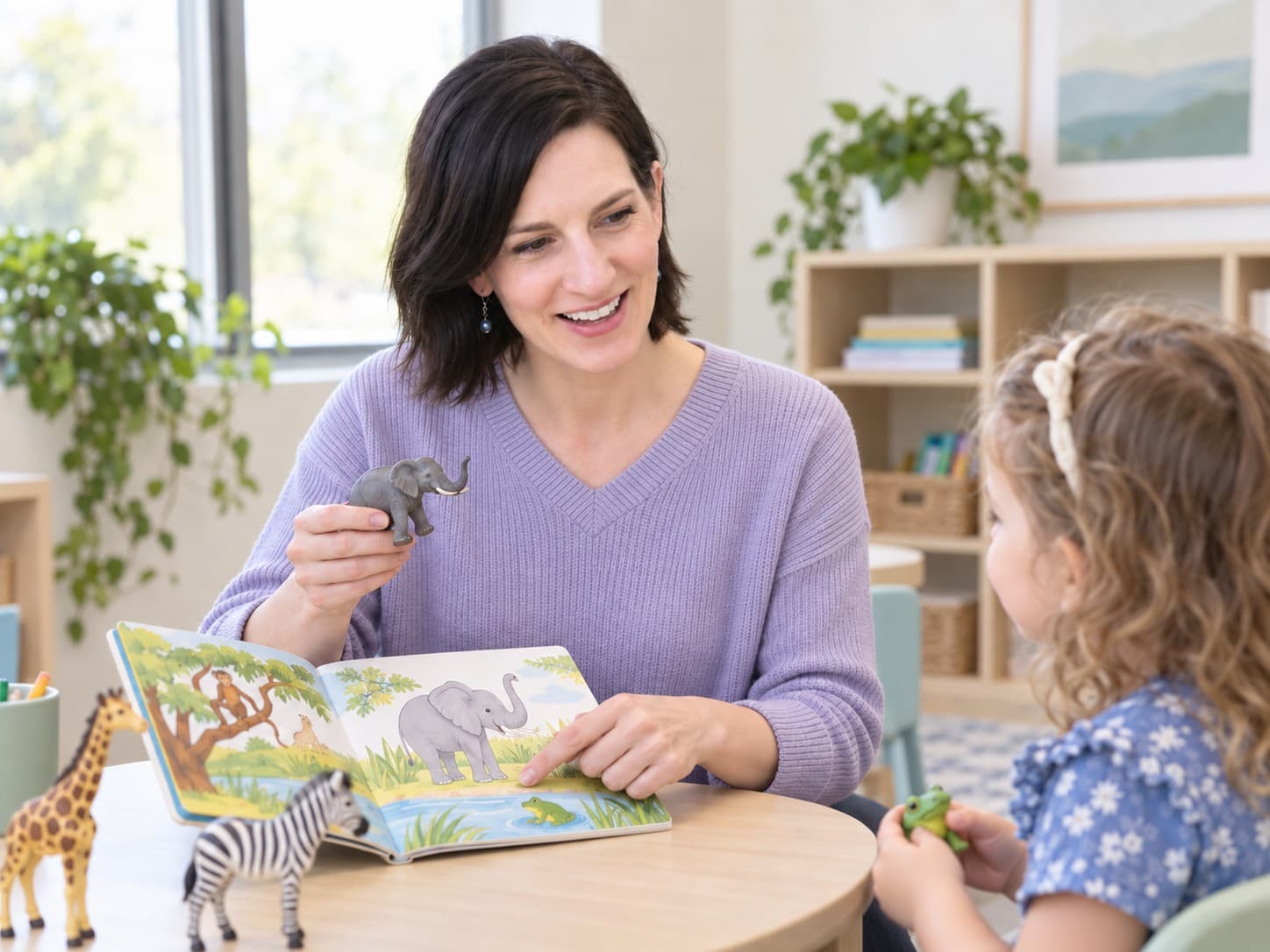
Sessions look like play because that is how preschoolers learn language. The clinician is still tracking targets: new words, longer phrases, question forms, following directions, or story retell seeds. Toys and books are tools, not babysitting with a medical bill.
Parents often sit in, especially with younger preschoolers, so the language moves used in clinic show up at meals, bath, and car rides. Coaching beats a binder of worksheets the child will never request. Home practice should feel like ordinary talk with a slight clinical tilt.
- Vocabulary growth tied to real routines
- Grammar and sentence length inside play
- Comprehension of questions and directions
- Parent language models you can reuse the same day
Understanding language before kindergarten becomes a scramble
Expressive words get the attention, but weak comprehension is equally costly. A child who cannot follow classroom directions looks noncompliant when the real gap is language. Preschool language therapy treats understanding as a first-class goal, not an afterthought once talking improves.
Teachers may notice the problem before relatives do, because school language is denser than home talk with familiar adults. Bring teacher notes to the evaluation. The sample should include how the child manages group directions, not only one-on-one play with a parent interpreting.
Parent role without turning home into a clinic
Caregivers are partners, not assistant therapists with a stopwatch. The useful parent role is consistent modeling, expanding the child's utterances, and creating brief practice moments inside routines that already exist. Shame-based drilling at dinner helps no one.
Ask your clinician which two or three strategies matter this month. More than that usually collapses into unused advice. Video snippets from home can help the SLP see how language works outside the therapy room, especially when the child is quieter with strangers.
When speech sounds sit beside preschool language
Some preschoolers are hard to understand because sounds are immature, because language is limited, or because both are true. Articulation or phonological work may run alongside language goals after evaluation separates the threads. Treating only clarity while vocabulary stays tiny, or only vocabulary while speech stays unintelligible, leaves half the problem untouched.
Diane Nilsson and Shane James both list child language among published interests, and Julia Price lists bilingual language development, which matters when more than one language is spoken at home. Bilingual exposure is not a disorder. Evaluation should respect the languages the child hears rather than forcing a false choice between them.
- Clarify whether unintelligibility is sound-based, language-based, or mixed
- Keep home languages in the conversation
- Coordinate with early intervention teams when overlap exists
- Revisit goals as kindergarten approaches
From early intervention into a preschool clinic plan
Children aging out of birth-to-three services often still need clinic-based language work. Summit treats that handoff as a clinical transition, not a paperwork cliff. Bring prior Baby Watch or early intervention goals so the new plan continues what worked and drops what no longer fits.
Telehealth can support parent coaching for some language goals across Utah when a clinician judges video adequate. Young children who need hands-on play assessment or who cannot attend on screen may still need in-person visits at a clinic the family can reach. The free consult is where that logistics question belongs.
Books, meals, and car rides as language labs
The best preschool language homework rarely looks like homework. Shared book reading with pauses for the child to fill in a word, mealtime labeling of actions and foods, and short car narrations of what you see out the window move therapy into ordinary life. Clinicians will show you how to expand a child utterance by one piece of information rather than correcting every error.
If a strategy feels unnatural, say so. A technique you will never use helps no one. Summit would rather send two strategies you will repeat daily than ten that die in a folder. Ask which routines in your week already have enough calm attention to support practice.
Video from home can be useful when the child is quieter with strangers. A two-minute clip of play or snack talk gives the clinician a fuller language sample than clinic alone. You do not need professional filming, only clear audio and a typical moment.
Preschool language at Summit is planned for the child in front of us, in Bountiful, Layton, or Murray, or on video in Utah when play and parent coaching can be seen well enough on screen. The free consult is where a clinician says which of those rooms should come first.
Hearing, attention, and other looks that sit beside language therapy
Language therapy cannot fix undiagnosed hearing loss. If hearing has not been checked recently, or if ear infections are frequent, raise that early. An SLP may recommend audiology while still beginning language support, depending on the picture.
Attention and regulation challenges can look like poor comprehension. The evaluation should try to separate language limits from situations where the child simply cannot sit for the direction. That distinction changes whether goals emphasize understanding words, shortening instructions, or coordinating with other providers.
Speech-language pathologists do not diagnose autism or ADHD as a medical rule-out clinic, but they do describe communication behavior carefully. If a broader developmental evaluation is underway, therapy can still address daily language needs without waiting for every specialty visit to finish.
Preschool language goals should name the contexts that already break down: circle time, playground entry, meal requests, or sibling negotiation. Generic talk more goals rarely change those moments. Diane Nilsson and Shane James list child language among published interests, and Julia Price lists bilingual language development when more than one language is spoken at home. Matching after the free consult considers those interests alongside the child's age and schedule.
- Ask about recent hearing screening dates
- Describe how the child manages group instructions at preschool
- Note whether frustration peaks at specific times of day
- Share other therapies already on the calendar so load stays realistic
Questions people ask before they call
Will my preschooler simply grow out of limited language without therapy?+
Some children do. Many do not, and waiting a full school year can make kindergarten harder. A screening or evaluation is how you learn which group you are in rather than arguing from neighbor stories. If frustration, weak understanding, or teacher concerns are already present, looking now is usually kinder than another year of hope alone. Frustration, hitting, or shutting down when talking is clinical data, not only a behavior footnote for later.
Do parents stay in the room during preschool language sessions?+
Often yes, especially for younger preschoolers. Clinicians coach the language you already use at meals, bath, and car rides so practice is not trapped in the clinic. Older preschoolers sometimes work more independently while caregivers still receive a short debrief. Ask for the model that matches your child's attention and separation needs. Younger preschoolers especially benefit when caregivers rehearse the same cues before the next daily routine starts. Separation needs and attention span should shape whether caregivers stay the whole session.
How is preschool language therapy different from teaching my child to memorize flashcards?+
Goals target vocabulary, grammar, and comprehension inside meaningful play and routines. Flashcard drills rarely create flexible language a child will use with peers. The evaluation names specific skills so sessions are not a vague push to talk more. Home practice should feel like slightly smarter everyday talk, not a second worksheet table at dinner. Two high-yield routines beat ten worksheets that never leave the backpack. Peer talk during play is a better progress check than flashcard accuracy alone.
My child mixes two languages at home. Is that the language delay?+
Bilingual exposure itself is not a disorder. Evaluation should consider both languages and avoid blaming code-mixing that is typical in bilingual development. Julia Price lists bilingual language development among published interests. Tell the clinician which languages are used with whom so testing and goals respect the child's real communication world rather than measuring only the language the preschool uses on weekdays. Code-mixing can be typical; language disorder can still exist and needs careful bilingual-sensitive testing.
What if preschool staff say my child does not follow directions?+
That note may reflect comprehension, attention, hearing, or behavior. Speech-language evaluation looks at language understanding directly instead of treating every missed direction as defiance. Bring the teacher's concrete examples from the same week. Hearing history matters too, and medical follow-up may sit beside therapy when indicated. Hearing checks and attention questions sit beside language goals rather than replacing them. Missed group instructions at circle time belong in the evaluation history with examples.
Can we use telehealth for preschool language work in Utah?+
Sometimes, when parent coaching and the child's attention work on video. Many young children still need in-person play assessment or treatment. A clinician decides after hearing the goal on the free consult. Out-of-state telehealth should not be assumed while Colorado, Wyoming, and Idaho licensing is still in progress. Parent coaching on video still needs a calm adult partner in the frame for most preschoolers. Nearby-state licensing in progress means out-of-state preschool telehealth should not be assumed.
We finished early intervention. Why would we still need preschool language therapy?+
Turning three does not erase language needs. Clinic-based preschool goals often continue vocabulary, sentences, and comprehension work with a different schedule and setting. Bring prior Baby Watch or early intervention goals so Summit can build continuity. The free consult is the place to map that handoff without duplicating services. Continuity across the third birthday prevents the common gap where services stop and kindergarten problems begin. Prior IFSP goals prevent restarting vocabulary work that already succeeded in early intervention.
What does a preschool language evaluation actually include?+
It typically includes caregiver history, standardized language testing appropriate for age, and a language sample from play or conversation. The clinician looks at vocabulary, grammar, understanding of questions and directions, and how the child repairs communication breakdowns. Results become specific goals rather than a vague push to talk more. Diane Nilsson and Shane James list child language among published interests that often match this caseload. Language samples from play often reveal grammar and repair skills that tests alone miss.